What Is ECU Tuning? A Plain Guide (2026) | RC Flash
What is ECU tuning? Learn how a tune changes boost, timing, fuel and torque limits, what it costs, and whether it’s safe for your engine.

What Is ECU Tuning? A Plain-English Guide
The short answer: ECU tuning means rewriting the calibration tables inside your engine’s computer (boost, ignition timing, fuel and torque limits) so they match your engine, your fuel and the way you actually drive. The factory sets them for the average car in the average market. A tune sets them for yours.
In this guide:
- What the ECU is
- How tuning changed from chips to flashing
- What a tune changes
- What it can and can’t do
- How the process works
- Is it safe?
- Cost, warranty and legality
- Which vehicles can be tuned
- FAQ
Ask ten people what ECU tuning is and you’ll hear “chipping,” “flashing,” “a remap,” and “opening the car up.” Someone will also tell you it voids your warranty and melts your engine. This page covers what actually happens.
What is an ECU?
The Engine Control Unit is a small computer that reads dozens of sensors and makes hundreds of decisions a second about fuel, spark, air and torque.
Two things live in its flash memory:
- The code: the program that makes the decisions.
- The calibration: thousands of numbers in tables. They say, for example, “at this engine speed, under this load, with air at this temperature, inject this much fuel, advance the spark this far, and allow this much boost.”
When people talk about “the file” being read, edited and written back, they mean the code and calibration together.
The factory calibrates for a wide range of conditions: different fuel grades, heat and cold, emissions certification, towing, and every part tolerance the platform shipped with. That is a sensible choice for a manufacturer. It also means your car was calibrated for the average of everything, not for you.
ECU tuning re-decides those numbers for one car, one climate, one fuel and one owner’s goals. It is the same calibration engineering the factory does, aimed at a single vehicle.
From chips to flashing: why there are so many names
The terms people argue about mostly reflect different eras.
- Late 1980s and 1990s: The calibration sat on a chip in a socket. Tuners unsoldered it and fitted a replacement. That’s where “chip tuning” comes from.
- Early 2000s onward: The memory moved inside the microcontroller, and the calibration could be rewritten through the diagnostic port. Tools used protocols such as KWP2000 and UDS, and later the standard J2534 pass-through interface, which made flashing widely available.
- Today: Europeans, especially in the VAG and diesel scenes, say “remap.” US shops say “tune” or “custom tune.” The tools are called flashers either way.
These words point at the same work. What really separates one service from another is who builds the file and how.
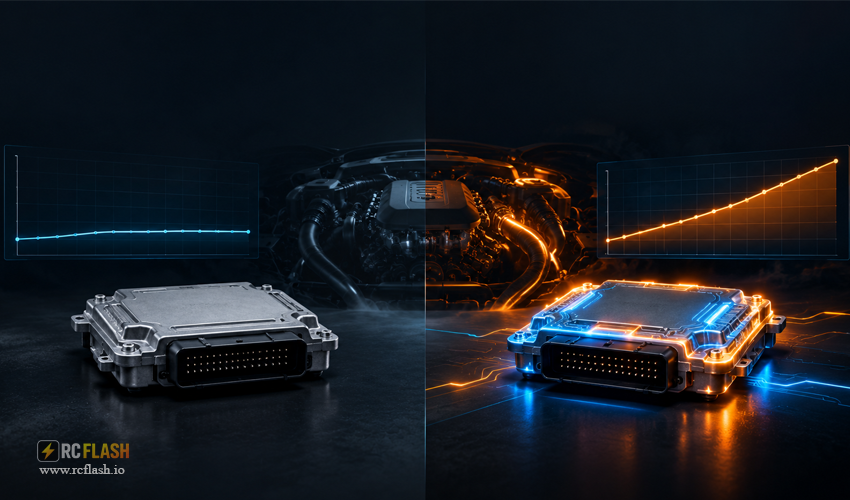
What a tune actually changes
A properly built calibration recuts a few families of tables:
Torque limits. Each gear has a cap on the torque the driveline may see. Manufacturers often set these for the weakest hardware sold with that engine. Raising the right ones is the biggest on-road gain on many stock cars, particularly diesels and automatics.
Boost and load targets. On turbo engines, these tables set what the turbo aims for. A good tune raises them only as far as the turbo stays efficient. Pushing further just heats the air.
Ignition timing. This map decides when the spark fires across speed and load. Conservative timing gives smoother, safer power. More aggressive timing gives sharper response, but only if the fuel can support it. A good tune ties the map to your octane and climate and leaves the ECU’s knock detection in place as a safety net.
Fuel. This covers injection quantity and mixture targets under load, including how rich the engine runs at full throttle. Extra fuel at full load is there to control combustion temperature.
Drivability. Throttle response, torque handoff to automatic gearboxes, shift behaviour, rev and speed limiters, and launch control. This is what most owners notice first. It’s also often where a hesitation you stopped noticing years ago gets fixed.
A tune does not change hardware. It makes a better version of the engine you already have.
What tuning can and can’t do
A tune can:
- Reshape the power curve so the power arrives where you drive.
- Remove factory compromises, like a dead spot near 2,500 rpm or a laggy throttle.
- Match the engine to the fuel you actually use (87, 93, E30, E85).
- Make towing and hauling smoother and, in some cases, more efficient.
- Restore useful low-end torque on diesel trucks and tractors without touching the emissions hardware.
A tune can’t:
- Turn the engine into a different engine. The turbo doesn’t get bigger because the software asks for more.
- Fix faulty hardware. A leaking charge pipe will just leak more under higher boost.
- Add large power “for free.” Be skeptical of any page that promises big gains on a stock engine with no hardware changes. That’s usually dyno correction, not engineering.
On emissions: some factory compromises exist for legal reasons, and we leave those alone. We don’t sell deletes or defeat devices for cars or tractors. The compromises that exist for warranty caution or worst-case part tolerance are different, and an owner can legitimately re-decide them.
How the process works, step by step
- Read. Your original ECU software is pulled through the OBD port with a J2534-capable tool. That stock file is the starting point, so the work is based on your actual ECU version, not a guess.
- Identify. The ECU part number, calibration version and controller family are matched against documentation. This is why “is my car supported?” is a technical question.
- Build. Maps are located by what they do, not by memory: where the torque model lives, where timing and boost are set, and which regions the checksum covers. [Describe your analysis method here in your own words, and confirm the “labelled ECU corpus / near a million signals” claim before publishing it.]
- Patch and correct checksums. The edits go in, and the file’s integrity values are recalculated. A file that fails its own check will be rejected. (See our guide to ECU checksum repair.)
- Write. Your tool loads the file the same way a dealer loads an update.
- Log and revise. You drive normally, on your fuel, roads and weather, and send back data logs: boost, knock counts, fuel trims and charge-air temperature. If anything is outside the intended range, you get a revised file based on what the logs showed.
That last step separates a tune built for your car from a file sold off a shelf.
Typical pricing at RC Flash: Stage 1 starts at $399 and includes one log-and-revision pass. Stage 2 starts at $599 with more revisions. Custom and E85 tuning is iterative. Diesel trucks, tractors and fleet work are quoted per job. The same loop applies to all of them.
For the tiers explained, see what a Stage 1 tune is and Stage 1 vs Stage 2.
Is ECU tuning safe?
It can be, and it depends on three things:
- The file matches your hardware. “Same chassis, close enough” is not the same.
- The file matches your fuel. Timing that suits E85 is wrong for 87 octane.
- Someone reviews your logs afterward. Knock, fuel trims, boost stability and temperatures show exactly how the engine took the new software.
Most “tuning blew my engine” stories involve a generic file sold to thousands of cars, with no revision step and nobody watching the results. The failures people fear (knock, lean running, overheating, driveline stress) all show up in logs. That is why a revision-based service is a safety feature and not an extra.
On legality: tampering with emissions controls is regulated in the US under the federal Clean Air Act, and rules differ by state and country. A file with the monitors disabled is also a worse file. It makes later faults harder to diagnose and can leave a car unable to pass inspection in some states. Keeping emissions systems intact keeps every fault code meaningful. [Add a link to the relevant EPA or state source here.]
Who should think twice about tuning
- Cars with known hardware faults, such as boost leaks, worn spark plugs or a weak fuel pump. Fix these first.
- Anyone who needs the car to pass emissions testing in a region that checks software calibration.
- Vehicles with an active powertrain warranty where you can’t accept any added risk.
How to spot a good tuner
- They ask for a stock read and your fuel type before quoting.
- They explain how revisions work and how many you get.
- They tell you plainly which platforms they don’t support.
- They offer a byte-exact return to stock.
- They don’t guarantee horsepower figures before seeing your car.
Which vehicles can be tuned?
It comes down to whether that controller can be read and rewritten safely.
- VW / Audi (EA888, 1.8T, TDI): Mature tool support; Simos, MED17 and EDC17 controllers. Good logs make for good revisions.
- Ford (EcoBoost, Coyote): [Confirm controller families before publishing.] Increasingly tuned for towing as well as power.
- Diesel trucks and vans: Bosch EDC7/EDC17 systems, where torque delivery and fuel economy matter more than peak numbers.
- Subaru (EJ): Denso controllers with a long open-source tuning community and a strong logging culture.
- Agriculture: Tractors and combines use similar controller families (Bosch, Cummins, Denso), often over J1939. The goals are different: implement-matched torque, fuel per acre and uptime, not dyno numbers.
ECU tuning vocabulary
| Term | Plain meaning |
|---|---|
| Tune / remap / flash / chip | Regional and era names for recalibrating ECU software |
| Stock read | The original file pulled from your ECU before changes |
| Calibration | The tables inside the file that get edited |
| Map | One specific table (ignition, boost, fuel, torque) |
| Checksum | The file’s self-check, recalculated after edits |
| J2534 | The standard interface used to read and flash |
| Datalog | A recording of sensor data while you drive |
| Revision | A new file built from your logs |
| Stage 1 / 2 / 3 | Tiers for stock hardware / modified hardware / built engines |
FAQ
What is ECU tuning in simple terms?
It means rewriting the calibration tables in your car’s engine computer, covering boost, timing, fuel and torque limits, so the engine is set up for your hardware and fuel instead of the factory’s general-purpose compromise.
What’s the difference between ECU tuning and remapping?
There’s no functional difference. “Remap” is the more common term in Europe and the UK, and “tune” or “flash” is more common in the US. In each case the ECU is read, the calibration is edited and the file is written back with corrected checksums.
Is ECU tuning bad for your engine?
A calibration built for your hardware and fuel, and checked against logs, stays within what the engine can handle. Problems usually come from generic files that ignore both.
Does ECU tuning increase horsepower, and by how much?
It depends on the platform, fuel and hardware. Turbocharged engines usually gain the most, and the amount varies by engine. On diesel trucks, low-end torque and towing behavior often improve more than the peak number. Be wary of anyone who promises a figure before seeing your car.
How much does ECU tuning cost?
Prices vary widely. Generic off-the-shelf files are cheaper, and custom calibrations with revisions cost more. At RC Flash, Stage 1 starts at $399 including one log-and-revision pass, and Stage 2 starts at $599. What you’re paying for is engineering time spent on your car’s logs, not just a file.
How long does ECU tuning take?
Turnaround at RC Flash is 3 business days for Stage 1 and 5 for Stage 2. Custom and E85 tunes are iterative once logs come in.
Does ECU tuning void my warranty?
A modified file can complicate a powertrain warranty claim. In the US, the Magnuson-Moss Warranty Act generally requires a manufacturer to show the modification caused the failure before denying coverage, but disputes still happen. The best protection is a byte-exact return to stock before any dealer visit. Ask your tuner whether their revert is byte-identical. [Have this wording checked for your market.]
Can a dealer tell if a car has been tuned?
If the tune is still on the ECU, yes. Dealer tools can see calibration and checksum differences. After a clean return to stock, traces are much harder to find, but on some platforms ECUs keep counters or logs, so no one can promise it’s undetectable.