ECU Checksum Repair Explained: Why Every Remap Needs It (2026)
ECU checksum repair explained: what a checksum is, why every remap needs one corrected, what goes wrong without it, and how it’s done right in 2026.
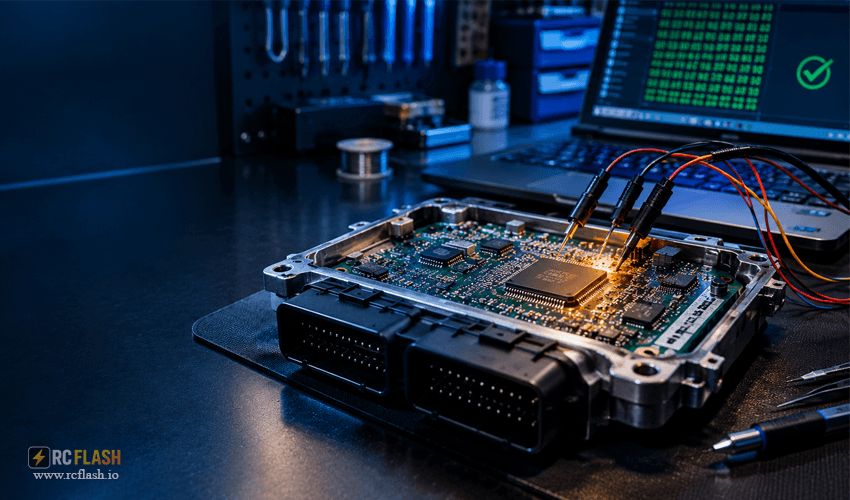
If you've spent more than ten minutes researching ECU remapping, you'll have run into the phrase at some point: checksum repair, or checksum correction. It shows up in tuner invoices ("checksum module license"), in forum posts ("did you get the checksums sorted?"), and in the scariest thread titles of all ("car won't start after remap, help").
And yet almost nobody writes about it clearly. It gets either ignored completely or buried in jargon so dense you'd think the author didn't want to be understood. That's a shame, because checksum repair is genuinely the hinge point of the entire modern tuning industry. It's the difference between a remap that works and a very expensive brick. It's the reason tuning a 2018 car costs more than tuning a 2008 car from the same manufacturer. And it's the single best vetting question you can ask a tuner before handing over your keys.
So let's do this properly. In this guide I'll explain what a checksum actually is, why your ECU cares so much about it, what "repairing" one really involves, why every new car generation makes the job harder, and what all of this means for you as an owner — including costs, failure symptoms, and the legal lines you shouldn't cross.
What Is a Checksum? The Plain-English Version
Every modern ECU has memory — flash memory, the same basic technology as a USB stick — and inside that memory lives the tuning data: fuel tables, ignition maps, boost targets, torque limits, injector calibrations, plus the underlying operating software.
Scattered around that data are small numbers called checksums. A checksum is the result of a calculation performed over a block of data — a sort of mathematical fingerprint. The logic is simple:
- The ECU (or a flashing device) takes a block of data, runs a formula over it, and gets a number.
- That number is compared against the checksum stored alongside the block.
- Match: the data is intact and trusted. Mismatch: something is wrong — the data is corrupted, truncated, or has been modified.
If you've ever zipped a file and seen a verification step, or downloaded something with an "MD5 hash" listed next to it, you've already used the same concept. Checksums in an ECU are the same idea, executed millions of times a second by a tiny computer that has zero sense of humor about being wrong.
A good mental model: the checksum is a tamper seal. The manufacturer sticks the seal on the file, and any future reader checks the seal before trusting what's inside. Break the seal — even by changing one single byte in one single fuel table — and every reader after that treats the file as broken goods.
Why Do ECUs Have Checksums? Two Reasons — One Advertised, One Not
The advertised reason: data integrity. Flash memory isn't perfect. It wears out, it can be corrupted by a failed or interrupted flash (imagine losing power halfway through writing 2 MB of calibration data), and chips occasionally develop faults with age and heat. A checksum lets the ECU detect bad data and refuse to run it. Given that the ECU controls fuel injection, ignition timing, and on a diesel potentially thousands of dollars of emissions equipment, "better to refuse than misfire on garbage data" is a completely rational design choice.
The less advertised reason: anti-tuning. From the mid-2000s onward — roughly the era of Euro 4/5 emissions rules and the widespread rise of diesel performance tuning — checksums became a deliberate obstacle for the tuning industry. If a hobbyist changes a boost map by hand and flashes the file back, the checksum walls off the change, and the car either refuses to boot or sits in limp mode shaking its head at them. This is not paranoia or speculation; the tuning tool industry's entire existence is built around it. Companies sell checksum correction tooling specifically because manufacturers made DIY modification hostile on purpose.
The practical consequence: nobody hand-edits modern ECU files anymore. Professional tuning is editing supported by checksum tooling — and understanding that changes how you see the whole market.

Where Checksum Repair Fits in the Remap Workflow
A professional remap, end to end, looks like this:
1. Full ECU read. The tuner connects via the OBD-II port (or bench-flashes the ECU with it removed, on locked platforms), and reads the complete contents of the flash memory — typically several megabytes — and archives the original, untouched file. This original is the one non-negotiable artifact of the entire job: it's the only thing that makes the process reliably reversible.
2. Map editing. The file gets opened in tuning software — WinOLS is the industry standard here, in the same way Photoshop is the standard in design. The tuner identifies the relevant maps (there can be dozens: torque limiters, boost targets, smoke maps on diesels, fueling per RPM point) and makes planned, logged adjustments.
3. Checksum repair — the invisible step. The moment one byte changes, every checksum governing the regions of memory that byte touches is invalid. The correct software recalculates each affected checksum and writes the new values back into the file, region by region. On a modern file this can involve a dozen or more separate regions, each with its own algorithm and its own stored value — and a single missed one ruins everything downstream.
4. Verification and flash. Before anything goes back to the car, the file gets checked: structure validated, checksums confirmed corrected, region by region. Then it's flashed through the same channel it was read from. A professional verifies success afterward — potentially data-logging the car, checking fault memory, confirming the car behaves at idle, part load, and full load.
The point of walking through that sequence is this: checksum repair isn't an optional add-on service. It's step 3 of 4, structural, mandatory. There is no such thing as a legitimate modern remap that skips it.
The Arms Race: Why Checksum Repair Got (and Keeps Getting) Harder
This is the part most articles skip, and it's the part that explains modern pricing more than anything else. Checksum complexity has roughly tracked the generations:
| ECU Era / Family | Typical Checksum Work | Difficulty |
|---|---|---|
| Early (1990s–mid-2000s) | Single simple sum over whole file | Trivial — spreadsheets could handle it |
| Bosch EDC15/16, ME7 era | A handful of checksums, known algorithms | Manageable with off-the-shelf tools |
| Bosch MED17 / EDC17 (Tricore) | Multiple independent checksums per region | Genuinely hard, requires paid modules |
| Simos 18+, MDG1 (BMW/Bentley/McLaren), latest Continental | Encrypted regions, AES checksums, flash counters, VIN lock | Specialist territory, expensive tooling |
A few specifics worth knowing, because they come up constantly:
Multiple independent checksums. A MED17 or EDC17 file doesn't have a checksum — it has many, covering different regions: the map area, the calibration identifiers, the firmware region, the counter area, and in some cases a security block. Fix the map checksum and ignore the ID block? The ECU still won't accept the file. Complete means complete.
Encrypted checksums. On locked modern ECUs, parts of the memory are AES-encrypted, and the checksum validation itself runs inside the encrypted domain. You can't recalculate what you can't read. Getting past that requires exploit-level access to the ECU's bootrom, a bench flashing device with licensed solutions for that specific family (Bitbox, Flex, KESS/KTAG, CMD, Autotuner, and similar tools are the usual names), and — critically — paying for the specific module covering your ECU version.
Flash counters and VIN locking. Some modern ECUs log every write to permanent memory, and some bind themselves cryptographically to a specific vehicle. Resetting these isn't strictly checksum work, but it lives in the same specialist neighborhood and is handled by the same tools and expertise. It's also the reason some modern cars simply cannot be tuned by mail-order file services the way a 2012 Golf could.
The takeaway: checksum difficulty has been on a one-way ratchet for fifteen straight years, and it has not stopped. Today is not the ceiling; whatever car you're shopping to tune this year will be harder to tune five years from now, not easier. Plan accordingly.
What Happens When Checksum Work Is Wrong — or Skipped
This is where theory turns into the story you came here for, probably because it's already happening to you or someone you know. The failure modes are well documented:
1. No start. The worst case, and the easiest to diagnose: the ECU refuses to boot a file that fails validation. You turn the key, get some dashes on the dash, and nothing else. This is actually the good version of a checksum failure, because it's unambiguous — nobody wastes a weekend on it.
2. Limp mode at startup, or shortly after. The ECU boots, runs briefly — sometimes for miles — then drops into a reduced-power safe mode and logs a generic "invalid calibration" style code. The car drives like a different, slower animal. This is the classic botched-file signature, and it's the failure most likely to send someone back to a cheap mobile remapper who then blames the wrong part.
3. "Ghost" sensor fault codes. Here's the one that causes the most real-world damage: a partial checksum failure frequently triggers implausible signal fault codes that point at perfectly healthy sensors — MAF, rail pressure, pedal position, lambda. Owners (and, to be fair, some genuinely good independent mechanics who don't know about tuning checksums) then replace the part, the light comes back, they replace another part. I've personally watched someone burn nearly a thousand dollars chasing a phantom MAF sensor on a remapped diesel, when what they actually had was a checksum that had been patched by someone who missed a region. The money was spent on symptoms rather than the cause.
4. The silent one: intermittent limp under load. Some checksums only guard against failure in specific operating states, or a comparison only happens at certain trigger points. A car can start, idle, cruise, and pass a test drive — then fall into limp mode the first time you demand full boost. This is the most dangerous failure because it's the hardest to reproduce at the shop and the most likely to be waved off as "if it's fine at idle, it's fine." A professional tuner validates the full file before flashing, and data-logs after flashing precisely to catch this one.
The Tools of the Trade — and Why They're Licensed
You can't checksum-correct a modern file with a calculator, and the industry's response was the paid module:
- WinOLS (EVC) — the editing studio. Its checksum modules are licensed per ECU family, and there are hundreds of them. A tuner covering the "big four" manufacturers typically holds a few dozen modules, each of which costs real money and requires actual renewal.
- Bench flashing tools — Bitbox, Flex (MagicMotorsport), KESS/KTAG (Alientech), CMD Flash, Autotuner, Scorpion. Beyond simply reading and writing, many of these handle checksums internally, and the more specialized ones unlock the reading itself on locked ECUs.
- Background services — a cottage industry of specialist checksum providers who correct files per-request. If a local tuner can't handle a rare platform, this is often what's happening behind the curtain.
The point of this list isn't to showcase tool names — it's to establish why a tune costs what it costs. A single MED17 checksum module is a real line item on a tooling budget, and that cost is reflected in the invoice at the end. A "free" tune on a modern car is, functionally, a hint.
Can You DIY Checksum Repair?
Realistically? Only in limited, old-car territory.
If you're working on a 2000s-era petrol with a single simple checksum, free community resources and patience can genuinely get you there — this is a well-documented, hobbyist-scale corner of the field, and there's real educational value in doing it.
Beyond that generation, the honest answer is: the barrier is knowledge-lock, not software. You can get the editing software; you can even watch tutorials. What you can't easily get is the specific checksum algorithm for your specific ECU revision — that's guarded, licensed, and updated every time a manufacturer quietly revises the ECU's internals. And even with the module in hand, damaging the wrong region of memory while half-understanding it can genuinely leave you with an unrecoverable ECU — at which point the repair bill is a replacement unit plus coding plus immobilizer work, which is several times the cost of the professional tune you were trying to avoid paying for.
There is a version of this advice that most DIY-oriented articles won't say: the checksum is the step that most reliably separates people who understand the file from people who don't. It's the discipline checkpoint. If you can't confidently complete it, the rest of the job isn't safe either.
What Checksum Work Actually Costs — and What It Should Tell You About Tuning Prices
Cataloguing high-end checksum module licenses is beyond the scope of a customer-facing article, but the customer-facing economics are completely knowable, and knowing them will save you money and grief:
- On pre-2010ish petrol cars, checksum work is minor and included in the job. Tuning costs are low because the file validation is routine.
- On 2010s Bosch MED17/EDC17-family cars, checksum work is a meaningful slice of the job and requires real paid tooling — this is the era where "remap" pricing starts visibly diverging by platform.
- On 2018+ locked ECUs, checksum plus unlock plus bench handling is a substantial fraction of the labor, because the module and the bench time are real. This is why "tuning a 2020 car" costs more than "tuning a 2012 version of the same car."
A rough and honest customer-side breakdown: the professional tune's invoice is made up of roughly these parts — editing expertise, checksum/licensing overhead (often the largest single line for locked platforms), bench handling where required, pre- and post-flashing verification, and the tuner's insurance. When you see a quote that's dramatically cheaper than market on a modern car, the thing being skipped is almost always the verification and checksum diligence — because that's the step whose absence isn't revealed until you're back on the road.
This is also why "return to stock" isn't automatically free. With a handheld device that stored your original file: free, in your driveway. With a one-off shop-installed laptop flash into a locked ECU: prepare for a bench session, because the checksum has to be corrected in both directions if the original file needs to be put back.
Choosing a Tuner: Checksum as Your Best Vetting Question
You don't need to understand checksums to use them well. You need exactly one question and the ability to hear the answer:
"How do you handle checksum validation on my exact ECU version?"
A professional answers immediately, specifically, and probably with tool names. Something like: "Your car runs a MED17.5.5 — I bench it, take a full backup, correct all five checksums in WinOLS with the EVC module, verify, flash, log afterward." That answer tells you they know your specific variant, they own the license, and they verify.
A bad answer looks like a shrug, a vague "we handle all of that," or evasion. And here's the specific false answer to watch out for: "It starts fine, so the file's good." Starting is not validation — as the intermittent-limp failure above showed, some checksums don't fail until you're at full load in fourth gear. If a tuner's only QA is "does it start," that isn't QA.
Two follow-up questions worth having in your pocket:
- "Will you give me a copy of my original file?" — A pro does this as standard. A file that isn't backed up is a file you can't reliably restore.
- "What's your process if I come back with a fault?" — Vouchers of one kind or another, logging sessions, a named point of contact. Vagueness here is a warning.
The Legal Line — State It Plainly
Everything in this guide describes legal tuning: remapping performance with emissions hardware intact, and correcting checksums so the modified file validates correctly.
But let's be adults about the market: checksum skills are, regrettably, the same skills used for the opposite job — defeating emissions monitoring. Recalculating checksums so an ECU no longer monitors EGR or DPF function, on a road vehicle, is the technical mechanism behind illegal deletes. In the United States, tampering like that violates the Clean Air Act, and federal enforcement has targeted tunes as well as deleted hardware — retailers and installers, not just car owners, have absorbed significant penalties. In the UK and EU, similar roadworthiness and emissions rules apply at inspection.
Recalculate checksums for a legal, full-emissions tune: fine, essentially everywhere. Same skill, aimed at hiding emissions tampering: illegal in both places, with real and mounting enforcement. The question a customer should be asking their prospective tuner isn't just about checksum competence — it's whether any of the work on the table would require defeating emissions monitoring. If the answer is yes, the answer is no.
Frequently Asked Questions
What is ECU checksum repair, in one sentence? Recalculating the ECU's stored data-validation values (checksums) after a file modification, so the modified file still passes the ECU's corruption checks and runs normally.
Is checksum repair the same as "unlocking" the ECU? No. Unlocking is gaining access to read/write a locked ECU in the first place; checksum repair is making a modified file valid once you have access. Modern jobs often need both, plus immobilizer work on some platforms, so the terms get mixed up.
How do I know if my checksum repair was done wrong? Typical signatures: no-start after the remap; immediate limp mode; fault codes pointing at sensors that test out perfectly healthy when swapped; intermittent limp only under full load. Any of these after a recent remap means the file, not the parts.
Can I repair checksums myself with free software? On older ECUs with a single simple checksum, sometimes yes — that's documented hobbyist territory. On modern locked ECUs, no; the algorithms are licensed commercial knowledge, and the wrong move can brick an ECU.
Why does checksum work make tuning expensive on newer cars? Every new ECU generation requires new reverse-engineering of its validation scheme, and the tooling is sold per-family as licensed modules. On locked platforms you're also paying for bench handling. That licensing and labor is a large, legitimate slice of the invoice.
Does checksum repair affect my warranty? Indirectly, yes — the remap it enables is itself a modification, and manufacturers can check ECU software versions during service. Separately, the file's checksum value being "correct" doesn't make a tune factory-original; a checksummed modified file is still detectable as modified by anyone who looks.
How long does checksum repair take? On unlocked older platforms: minutes, as part of the normal job. On locked modern ECUs requiring bench work: adds real time to the job — often the removal/reinstallation plus flashing process adds an hour or more, and that's before any verification.
Do I need a checksum repair "service" if I bought a pre-built tune file? If the file provider sold you a fully corrected file for your exact ECU version, possibly not — but verify, because a file built for a neighboring ECU version, or one that's generic rather than platform-exact, is exactly where checksum failures hide. Cheap file sellers are the most common source of this exact problem.
Final Thoughts
Checksum repair is the invisible half of the remapping business. Handled right, it's the reason a remap drives cleanly, passes its tests, and can be reversed. Handled wrong, or skipped, it's the reason a car sits in a driveway refusing to start while its owner learns a new vocabulary of fault codes.
The good news is that as an owner or customer, you don't need to do checksum work — you need to recognize it. You now know where it sits in the workflow, why it got harder, what its failure modes look like, and the one question that separates a professional from a pretender in about ninety seconds.
And the one boundary worth repeating, because it's the sharpest line in this industry: checksums are neutral math. What they get used for is everything. Legal tuning keeps every emissions system intact and validates a modified file honestly. Illegal tuning uses the exact same math to hide emissions removal. Same skill, opposite liabilities. Choose your tuner accordingly — pay for the checksum work, and skip the rabbit hole that makes it expensive.